"Rooted helps users find the right plants for their homes with expert guidance, eco-friendly delivery, and smart care tips, all in one seamless experience."

Project overview
What is Rooted?
Rooted is a fresh and fun online shop where people can buy all kinds of indoor and outdoor plants, pretty pots, bouquets, and plant care products.
I also created a website for it as part of my project!
February 2025 _ May 2025
Week
Website - Web App
Platform
+ 50
Screens
Product Designer
My Role
The proses was like ...
.1
Research . Capitative Analyse . Discover goals ,problem
.2
User research . User survey and interviews . Customer Journey Map . User Personas
.3
Information Architecture . user Flow . Low and High Wireframes . Crazy 8s
.4
Style guide . components . Desktop Ul Design . Web app Design . Prototyping .
.5
crafting presentation

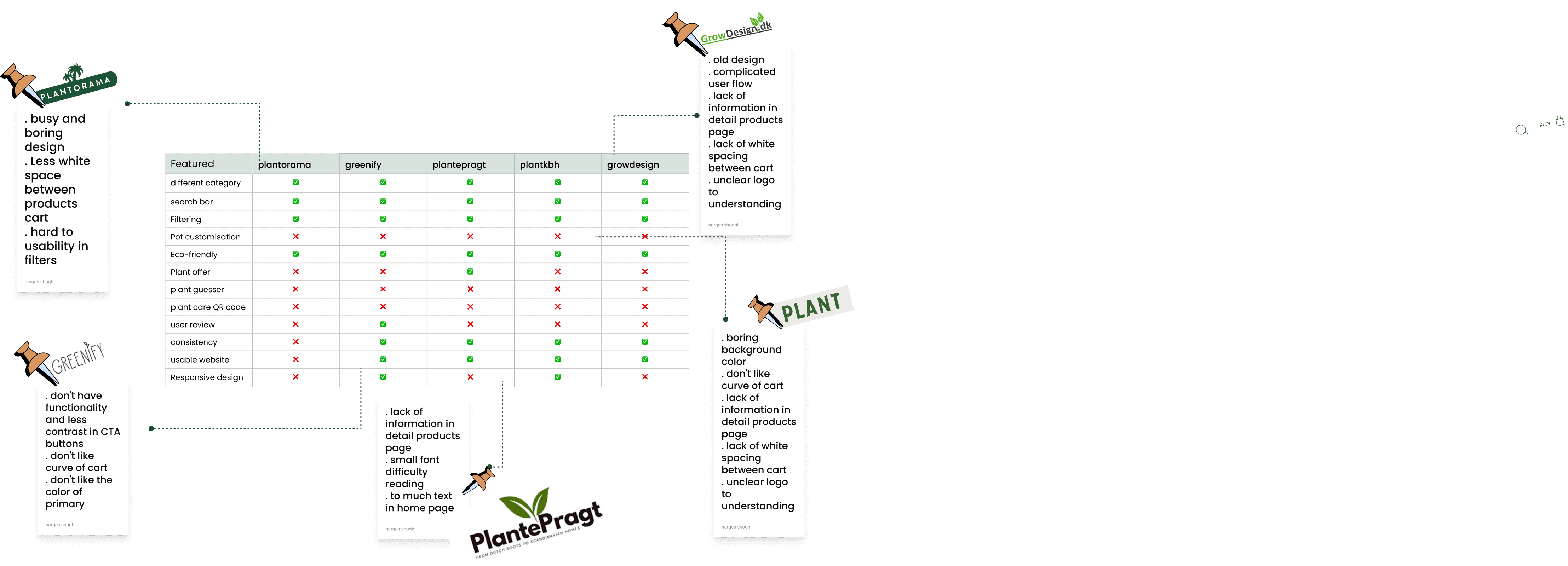
Competitive Analyse
Responsibilities
The process started with general research, benchmarking and competitor analysis. It wes lots of products from both global and local markets. Even tough in Denmark, you can buy plant in(local market like Netto).

Pain Point
User Research
Users are the main factor in the journey. That's why I spent a lot of time here in the stage of user research.
That’s why I went to the Planturama shop to see what services they don’t have, so I can bring them to my website.


Persona
"Flowers are a magnificent gift to make others happy."

Anna
"Flowers and plants are great way to cultivate your mood."

Rayan&Rebeca
User flow

Logo
The Rooted logo is simple, modern, and clear. It uses green to show nature and growth. The name and logo are mixed together as one. The letter “O” is designed with a leaf, making a unique and easy-to-remember symbol. It shows a smooth connection and a friendly, eco-friendly feel between Rooted and its customers.

Safezone
To keep the logo clear and easy to see, always leave some empty space around it. Don’t put any text, images, or other elements too close. This helps the logo stay clean and easy to read everywhere.

Logo Variations
These logo variations are designed for use across different background types and must be consistently applied to maintain a cohesive brand identity for Rooted.

Wireframe
In the Rooted project, I followed the Design Craze 8 framework to guide the design process from research to final visuals. I began with low-fidelity wireframes to quickly explore layouts and user flows, then refined them into high-fidelity wireframes with detailed visuals, branding, and UI elements—ensuring a smooth and user-centered experience throughout.


color plate


I picked the Poppins font because it looks clean, modern, and is easy to read. Its simple shapes feel friendly and welcoming. It works great on both screens and paper, so it can be used everywhere.
Typography
Components

Mockups

Prototype
In the prototype section, I created interactive mockups to visualise the user journey and design elements of the application. This allowed for testing usability and gathering feedback on key features before final development.

Key Feature

Usability test
Usability testing
Using Figma, I conducted a moderated user test with an observer. I set tasks and asked users to express their thoughts and feelings while working with the prototype.
Core tasks
The task was to order a plant using a guided questionnaire that helps the user choose from recommended plants. After placing the order, the user can upload a photo of the plant to the website to receive personalised care guidance.
Methodology
Moderated Usability Test
Participants
Participants: Anyone with experience buy plants online.
Operating System: Website
Age Range: Any
Gender: Any
Result’s summary
After testing these two flows, I realised that creating a mobile-friendly version was essential.
Most users naturally scan QR codes with their smartphones, making it the primary device for accessing care instructions.
Similarly, completing the questionnaire is often more convenient on a mobile phone, since users might not always have a laptop or tablet at hand.
By optimising these flows for mobile, the experience becomes faster, easier, and more accessible in real-life situations.
As a result, I decided to design all the pages for the full Rooted web app, ensuring that users could easily browse, select, and purchase plants without friction across the entire experience.


Reflection
From the Rooted project, I learned the importance of designing for the devices users actually use. For example, most people scan plant care QR codes on their phones, so ensuring a smooth mobile experience was essential. This taught me to always consider when, where, and how users will interact with a feature.